Why DUI Cases in Riverside Fail Without the Right Riverside DUI Lawyer

Have you ever had that split second after blue lights hit your mirror, when your mind starts racing through worst-case outcomes? If you face a DUI arrest in Riverside, the case can feel “straightforward” at first. It is not.

Small errors, early delays, and bad assumptions can shrink your options fast. Most people do not lose because the facts look terrible. They lose because nobody attacks the case early, the DMV piece gets ignored, and the story gets written for them.

That is where the right Riverside DUI lawyer changes the direction, not with promises, but with tight work and timing.

Why DUI Charges in Riverside Are Harder to Fight Than Most People Expect

A Riverside DUI case can move on two tracks at the same time.

  • The criminal court focuses on the charge, evidence, and penalties
  • DMV administrative action focuses on your driving privilege, deadlines, and suspension risk

That split catches people off guard. Many also assume the breath test number ends the discussion. It does not. The case often turns on process.

Focus areas that shape outcomes:

  • Reason for the stop: Officers must justify the stop with facts
  • Probable cause to arrest: The arrest needs support beyond a hunch
  • Field sobriety test conditions: Footwear, surface, lighting, injuries, anxiety
  • Chemical testing details: Timing, handling, maintenance, chain of custody

This is why Riverside DUI defense requires early attention and a detailed review from the start.

The Most Common Reasons DUI Cases Fail in Riverside

Most DUI cases do not collapse from one big mistake. They weaken from a stack of small ones.

  1. Missing the DMV deadline: People wait for the court date and forget the DMV process. That delay can trigger a suspension before the first real fight starts.
  2. Talking too much after the stop: Drivers try to “explain it.” Officers document every detail. Small admissions turn into big building blocks later.
  3. Taking plea deals before reviewing evidence: A fast deal can look tempting. A fast deal also locks in penalties when defenses exist.
  4. Treating field sobriety tests as “required”: Officers use them to gather observations. Bad conditions can make sober people look impaired.
  5. Ignoring medical and practical factors: Acid reflux, diabetes, certain diets, mouth alcohol, fatigue, anxiety, and medications can affect how officers interpret signs and tests.

How the Wrong Riverside DUI Lawyer Can Weaken a Case

A weak defense does not always look weak at the start. It often looks “easy.”

Common patterns that hurt clients:

  • Late start: weeks pass before anyone requests reports, videos, calibration logs
  • Surface-level review: the lawyer reads the arrest report once and stops
  • No motion strategy: no targeted challenges to the stop, arrest basis, or testing
  • No DMV focus: the license issue gets treated like a side topic
  • Low communication: clients guess what happens next and make risky choices

A DUI case needs pressure in the right places. If the defense never applies that pressure, the prosecution has no reason to adjust.

What the Right Riverside DUI Lawyer Does Differently

Strong DUI defense starts with discipline and a clean plan. It also starts early.

You typically see these differences:

  • Fast evidence capture: police reports, body cam, dash cam, dispatch audio
  • Timeline analysis: drinking pattern, last drink, driving time, test time
  • Test scrutiny: device maintenance, sample handling, lab procedures
  • Stop and arrest challenge: the defense checks the legal basis step by step
  • DMV alignment: the court strategy and DMV strategy support each other

We take cases apart from the first week, because timing decides leverage in many Riverside DUI files. We also keep clients ready for the next step, so they do not walk into court or DMV actions blind.

How Kia Law Firm Helps Prevent DUI Case Failures

We handle DUI defense, and we also understand what happens when an arrest involves a crash and injuries. Some clients face a criminal DUI case while also dealing with insurance claims, medical treatment, or rideshare involvement.

Kia Law Firm also works with Lyft and Uber crash injury matters as part of personal injury representation. That matters when:

  • You rode as a passenger
  • Another driver hit you while a rideshare driver operated nearby
  • You walked or biked, and a rideshare car hit you

Kia Law Firm supports clients with:

  • 24/7 availability and responsive communication
  • Local Riverside and California law focus
  • Contingency fee representation for injury claims
  • Full case handling from evidence to negotiation and trial prep

We keep the plan practical, and we do not treat clients like files in a stack.

Riverside DUI Cases That Fail vs Those That Succeed

Now let’s make this practical. Two Riverside DUI cases can start the same way and end very differently, based on what gets handled early and what gets ignored. The comparison below shows the decision points where outcomes usually shift.

Decision Point When Cases Fail When Cases Hold Strong
First 7 days Client waits and gathers nothing Defense requests reports and video fast
DMV action Client misses hearing the request Defense protects the license strategy early
Stop review Nobody challenges the reason for the stop Defense tests facts and legality
Testing Everyone treats BAC as final Defense checks timing, method, and handling
Negotiation Plea happens before leverage Motions and evidence gaps drive better outcomes


That gap is not luck. It comes from timing, evidence control, and whether the defense treats the DMV and court process as one coordinated plan. When the early steps stay tight, the later negotiations and court results usually improve.

When a DUI Case in Riverside Is Still Worth Fighting

Many DUI cases still deserve a real fight, even when the arrest report sounds confident.

Situations that often raise real defense angles:

  • Borderline BAC results near the legal threshold
  • Rising BAC scenarios where testing time matters
  • Weak driving pattern evidence with minimal objective facts
  • Questionable stop reason based on vague weaving claims
  • Non-standard testing conditions that increase error risk
  • Medical factors that mimic impairment signs

A serious defense does not depend on luck. It depends on what the evidence truly supports and what it does not support.

How to Choose the Right Riverside DUI Lawyer Before It’s Too Late

You do not need slogans. You need signals of real work.

Ask questions like:

  • “Will you handle the DMV hearing strategy too?”
  • “What evidence will you request in the first week?”
  • “Do you file motions when the stop or arrest looks weak?”
  • “How do you evaluate breath and blood testing details?”
  • “How often will I hear from you, and how do you update me?”

Red flags:

  • Guarantees, or “no need to worry” talk
  • Pressure to plead before reviewing evidence
  • Vague answers about DMV deadlines and testing review

Final Thoughts

A Riverside DUI case can fall apart in silence. One missed DMV deadline, one sloppy evidence review, one rushed plea, and the case starts deciding itself. You still have control if you move early and treat the case like a technical file, not a moral argument. The right defense tests the stop, the arrest basis, the field sobriety conditions, and every step in breath or blood testing, then uses those weak points to push for a better result.

If you want real direction and a clear plan, speak with a Riverside dui lawyer who builds leverage from day one. Call Kia Law Firm to book your consultation today, and let’s start protecting your license, your record, and your options, we.

FAQ

1. Can I still fight a DUI if I “felt fine” but the officer wrote I looked impaired?

Yes. Officers write subjective observations. A defense can test the stop facts, conditions, and objective proof, like video, timing, and testing method.

2. If I refused a chemical test, does that mean I automatically lose?

Refusal creates serious issues, but defenses still exist. The case may still involve stop legality, arrest basis, and DMV procedures.

3. Can I travel for work while my DUI case stays open?

Often yes, but conditions vary. Court dates, travel limits, and probation terms can affect this. Ask your lawyer before booking.

4. Does a DUI stay on my record forever in California?

A DUI can stay on your driving record for a long time, and it can affect future penalties. Some people may qualify for certain post-case relief steps depending on the outcome.

5. Can I keep my job if my role involves driving?

It depends on your license status, employer rules, and whether the court or DMV imposes restrictions. A fast DMV strategy can matter a lot here.

What Prosecutors Expect You to Do, According to a Riverside Criminal Defense Attorney

Have you ever wondered why the prosecutor seems so sure of the next step before you even walk into court? They run cases on patterns, not surprises. Most defendants repeat the same early mistakes, and the prosecution prepares for those moves. A Riverside criminal defense attorney spots that pattern fast and breaks it before it turns into leverage.

Now let’s connect the dots, step by step, so you can see what they expect and what actually protects you.

Why Prosecutors Rely on Predictable Behaviour

Prosecutors do not need a perfect case to move forward. They need momentum. They count on routine mistakes that make files cleaner and negotiations easier for them. They expect predictable behaviour because it creates three advantages:

1) It Locks Your Story Early

When you talk, apologise, or explain, you often add details you cannot take back. Prosecutors love early statements because they reduce uncertainty.

2) It Keeps You Reactive

If you wait for the court to “start the real process,” you give the other side time to shape the first impression. First impressions turn into charging positions.

3) It Increases Pressure Without Effort

Most people feel stress from silence, delay, and lack of answers. That stress pushes rushed decisions.

What prosecutors quietly expect from you:

  • You will talk to the police to “clear things up.”
  • You will text people involved and create new evidence
  • You will miss small deadlines because you feel overwhelmed
  • You will delay legal guidance until the last minute

That list does not mean you did anything wrong. It means the system runs on predictability.

What Prosecutors Expect You to Say After an Arrest

Prosecutors and investigators expect people to talk. They often get what they want in the first 24 hours, because that is when you feel shocked, tired, and eager to “clear it up.”

They expect statements that sound harmless, like:

  • “I was there, but I didn’t do anything.”
  • “I only did this part.”
  • “It was a misunderstanding.”
  • “I didn’t mean it.”

Those lines can still create problems. They can confirm presence, access, knowledge, or intent. And once a report includes your words, you can’t pull them back.

They also expect people to talk in places that feel casual:

  • In the patrol car
  • During booking
  • On recorded jail calls
  • In texts to friends, family, or coworkers

That material becomes evidence. It also shapes how the prosecutor decides the next move.

At the same time, California requires structured information-sharing during the case. Prosecutors have disclosure duties, including turning over witness information, relevant evidence, and exculpatory evidence under Penal Code section 1054.1.

But that process does not protect you from what you volunteer for early. Your own statements still sit in the file. So the best mindset stays boring and disciplined: let the defence control messaging, and avoid producing new evidence. Once you understand that, the next question becomes what prosecutors expect you to do in the quiet window before your first court date.

What Prosecutors Expect You to Do Before Your First Court Date

The period between arrest and early court dates decides more than people realise. Prosecutors expect most defendants to waste that time.

They expect you to:

  • Wait for the court to explain everything
  • Assume the DA will “be fair” once you tell your side
  • Miss deadlines because you feel overwhelmed
  • Accept the conditions of release without understanding how they affect the case

This is why this early window matters. The court system runs on deadlines. California gives defendants specific timing rights that shape leverage. For example, speedy trial rules under Penal Code section 1382 set deadlines that differ by custody status and case type.

In felony cases, the process also moves through pretrial steps that often include a preliminary hearing, where the judge decides if enough evidence exists to move forward. In real life, prosecutors hope you do not pay attention to those moving parts. They prefer you stay passive, because that keeps the state’s narrative unchallenged.

This is also where one detail matters in Riverside: a large share of arrests involve lower-level, non-violent matters. Riverside Police Scorecard data shows that 57% of arrests from 2013–2023 fell into low-level, non-violent categories. That does not mean “nothing happens” in those cases. It means many people get pulled into the system for issues that still carry record risk, probation terms, and long-term consequences if they mishandle the early stage.

Here is the direct connection: when someone treats a “minor” case casually, prosecutors gain room to push conditions and deals that stick for years. This is where you want a defence plan that interrupts momentum instead of chasing it.

How a Riverside Criminal Defense Attorney Disrupts These Expectations

A Riverside criminal defense attorney changes the direction of the case by interrupting the prosecution’s comfort zone. The goal is not noise. The goal is control. A strong defense disrupts the standard pattern through:

  • Controlled communication: you avoid casual statements that become evidence
  • Early review of reports: you check assumptions, gaps, and inconsistencies
  • Timeline discipline: you prevent the prosecution from defining “what happened” alone
  • Pressure with purpose: you use motions and procedures to force real review

This work matters because prosecutors often build their confidence on silence from the defense side. Once you show structure, they start reassessing. That shift sets up the next piece: the client-specific system that keeps people steady under pressure.

How Kia Law Firm Helps Clients Stay Ahead of Prosecutorial Strategy

Kia Law Firm builds strategy early, not after the first hearing. We step in to limit exposure, tighten the timeline, and keep decisions clean. We keep clients in Riverside grounded because confusion makes people talk, and talk creates risk.

Kia Law also brings strength from personal injury work, including Lyft and Uber matters. Lyft claims sit under personal injury law, but they often carry layered insurance rules that change based on driver status. Kia Law handles cases for passengers, other drivers, and pedestrians.

What clients get:

  • Local Riverside familiarity and practical case planning
  • Direct communication and tailored strategy, not templates
  • Contingency fee structure for injury cases, no fee unless recovery
  • Full case management: evidence, medical records, negotiation, trial prep if needed

We hold the line on pressure and keep the file organised, because outcomes follow discipline.

Common Mistakes That Align With Prosecutor Expectations

Mistake Why It Helps the Prosecution
Talking without counsel Creates fixed statements
Missing early filings Signals disorganisation
Sharing documents freely Locks timelines
Delaying strategy Allows case momentum
Assuming fairness Reduces negotiation power

These mistakes often come from stress, not bad intent. Still, prosecutors expect them. When you avoid them, you stop feeding momentum.

When Prosecutors Change Their Approach

Prosecutors change course when they see risk. They reassess when the defence forces carefully review, instead of letting assumptions settle.

They adjust when:

  • The defence challenges credibility gaps in reports or witness claims
  • The evidence does not match the charging theory
  • Time pressure and deadlines start to matter
  • The defence shows readiness for motions and trial preparation

In other words, prosecutors shift when they stop seeing you as predictable. This is where continuity matters. Early discipline creates later leverage. If you control statements, control timelines, and push structured review, you set the tone for negotiations and court outcomes.

Final Thoughts

Prosecutors expect predictability because it simplifies their work. Breaking that pattern changes everything. When guidance starts early, pressure shifts, clarity improves, and outcomes follow strategy, not fear.

Speaking with a Riverside criminal defense attorney early keeps control where it belongs. If you want steady guidance and direct answers, we are ready to step in and help you move forward with confidence.

FAQs

  1. Should I speak to the police if I believe I am innocent?
    No. Innocence does not prevent statements from being misunderstood or misused later.
  2. Can early legal help reduce charges before court?
    Yes. Early intervention often influences charging decisions and negotiations.
  3. Do prosecutors review body camera footage immediately?
    Not always. Many early decisions rely on written reports alone.
  4. Can minor charges still affect my record long term?
    Yes. Even low-level offences can carry lasting consequences without proper handling.
  5. Does hiring a lawyer early make me look guilty?
    No. It signals awareness, not guilt, and protects your position from the start.

Felony Domestic Violence Charges and Related Strikes Dismissed on Jan 7, 2026. Client pleads to a misdemeanor.

Our client was facing multiple strike allegations of domestic violence charges. Through successful negotiation, we were able to have the client plead guilty to one misdemeanor charge of domestic violence.

 The strike allegations were dismissed and the felony was reduced to a misdemeanor.

CLICK HERE for a copy of the Complaint alleging the felony charges.

CLICK HERE for the MINUTES that reflect the resolution of the case.

AT KIA LAW FIRM, we work hard to get you the best results. Call or text us with any questions you may have.

What Are Common Legal Defenses Against Attempted Crime Charges?

When someone says you “attempted” a crime, it can feel unreal. Like the story being told about you isn’t the one you were living. Maybe there was confusion, maybe you were in the wrong place, or maybe it looked worse than it was. Attempt charges are strange that way. 

The act doesn’t even have to happen, yet it can still shake your future. So, the real question becomes what was meant, and what actually occurred. A criminal defense attorney in Riverside helps you sort through that difference, piece by piece.

What Constitutes an Attempted Crime?

Under California Penal Code §21a, attempt means a person had specific intent to commit a crime and performed a direct but ineffectual act toward completing it. Not planning. Not thinking. A real, tangible step.

Prosecutors must prove both elements beyond a reasonable doubt. Even then, penalties under Penal Code §664 usually reach only half the sentence of the completed offense, except serious cases like attempted murder.

Sometimes, courts even dismiss charges when evidence shows lawful self-defense or a lack of intent to commit any crime. Those details matter more than most realize.

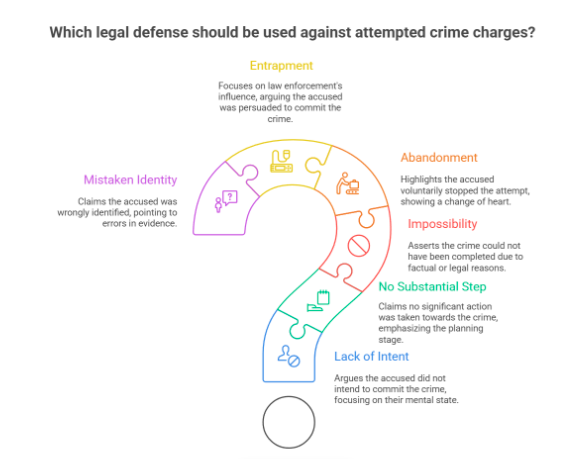
Common Legal Defenses Against Attempted Crime Charges

When you face an attempt allegation, your lawyer’s job is to break the state’s theory apart, piece by piece. Every element counts, and if one fails, the entire charge can collapse.

Lack of Intent

Attempt hinges on intent. Without proof of it, there’s no crime. Your lawyer can show that your actions lacked purpose, were accidental, or were misunderstood.

Courts sometimes reassess charges when evidence clearly shows lawful self-defense or no specific intent to commit an offense.

No Substantial Step

In California, you must take a direct but ineffectual act, not mere preparation. Planning alone, buying tools, researching online, or even talking, doesn’t equal an attempt.

Example: driving near a location isn’t enough; entering with tools ready could be. The difference sounds small, but it means freedom or conviction.

A criminal defense attorney in Riverside knows how to draw that line for juries.

Impossibility

Here’s a tricky one.

  • Factual impossibility (like trying to steal from an empty pocket) is not a defense.
  • Legal impossibility (where the act wouldn’t actually be illegal) can be a defense, though rare.

Type of Impossibility Example Defense Valid in California
Factual Trying to steal from an empty wallet No
Legal Attempting to do something not criminal Sometimes

Footnote: In California, factual impossibility is not a defense; legal impossibility may be.

Abandonment or Withdrawal

It happens, you change your mind. But under state law, once a direct but ineffectual act occurs, voluntary abandonment is not a defense. If you withdraw before that step, it might show a lack of intent, helping your case. Timing is everything. Your attorney can use early withdrawal to prove hesitation, not guilt.

Entrapment

Sometimes, people get pushed too far by those meant to uphold the law. California follows an objective test (from People v. Barraza): if police conduct would likely make a normally law-abiding person commit the crime, that’s entrapment. It’s about police behavior, not your past.

The U.S. Department of Justice explains entrapment applies when “the accused person alleges that he never would have committed a crime if a law-enforcement officer had not inspired, incited, persuaded, or lured him.”

A  criminal defense attorney in Riverside uses this to reveal when enforcement crossed the line.

Mistaken Identity or False Accusation

Surveillance gaps. Unclear footage. Eyewitness errors. Many attempted cases rest on poor identification. Showing inconsistencies, false assumptions, or motives behind accusations can completely dismantle the prosecution’s case.

The Role of Evidence and Legal Strategy

Evidence makes or breaks attempt cases. From text messages to witness statements, every detail matters.

Your lawyer tests not just what exists, but how it was obtained. Chain of custody, warrant limits, and police questioning; each can decide whether evidence survives.

  • Track how law enforcement gathered statements or digital records.
  • Compare witness accounts against timelines.
  • Use everyday language to challenge claims of “intent.”
  • Recreate the event from your point of view.

Case Study (October 16 2025) – All Felony Charges Dismissed: We handled a case where the state claimed an attempted felony. After showing inconsistent witness timelines and a lack of a direct act, all charges were dismissed before trial. That’s what careful analysis and persistence can do.

Why Hiring an Experienced Criminal Defense Attorney Matters

Attempt charges feel heavy, but experience cuts through fear. When you work with us, you don’t face it alone.

  • We examine every element under Penal Code §21a for flaws.
  • We challenge how the police interpreted your actions.
  • We know when “attempt” crosses from theory to reality.
  • We’ve won dismissals in Riverside courts for clients accused of serious felonies.
  • We stay reachable, explain plainly, and fight hard for your story.

A seasoned criminal defense attorney in Riverside sees patterns in these prosecutions. At Kia Law Firm, we don’t sell promises; we build defenses grounded in law and proven results.

Our team’s focus is simple: protect your record, freedom, and future. You can explore more about our defense services through our Practice Areas page.

Final Thoughts

Facing an attempt charge doesn’t mean guilt. California law recognizes intent, action, and fairness. With the right defense, you can prove what truly happened and protect your name.

At Kia Law Firm, we’ve seen lives change when clients fight back early, with facts, not fear.

If you or someone close is accused of an attempted crime, contact our team now through our Practice Areas page or reach out directly. Get clarity, real answers, and a path forward today.

FAQs

  1. What counts as an attempted crime in California?

Attempt means having intent and taking a real step toward a crime, even if it fails. Not plans. Not words. A step that actually mattered.

  1. Can changing your mind cancel an attempt charge?

Only if you stop before any direct act happens, once that line’s crossed, it’s too late. Your lawyer may still show hesitation, though.

  1. Is factual impossibility a defense?

No. If someone tries to steal from an empty wallet, it’s still an attempt. The law sees effort, not success, and that’s the key.

  1. What’s the difference between entrapment and persuasion?

Entrapment happens when police pressure someone who wouldn’t usually offend. Persuasion is softer, no trick, just words. The line’s thin, but real in court.

  1. How can a criminal defense attorney help in attempt cases?

A lawyer challenges what the state calls “intent,” picks apart weak proof, and explains your actions to the jury in plain, human terms.

  1. What penalties apply for attempted crimes?

Usually, about half the sentence for that crime. Penal Code §664 says so. But exceptions, like attempted murder, carry heavier punishment.

What Determines Whether a Crime Is Charged as an Attempt or a Completed Offense in California?

Sometimes things happen fast. Faster than you expect. And you end up standing in a moment you did not think would ever come. You worry about what charges might mean. You read words you never wanted to read. Attempt. Completed offense. And then you realize something important. 

The difference between the two can change the entire direction of your life. If you are searching for guidance or looking for a criminal lawyer in Riverside, CA, you are likely in the stage where clarity matters. 

This explains how California separates an attempted crime from one considered fully completed, in a way that is simple enough to follow when the situation feels heavy.

The Difference Between Attempt and Completed Crime

A completed crime is the full act. It is when the intended unlawful act has actually occurred. The attempt is different. Attempt means the person intended to commit the act and took some steps toward it, but the act itself did not fully happen.

Understanding this matters because punishment changes. The state looks closely at intention and action. Sometimes the difference can be one small detail, one moment, one unfinished movement. And those small details become the center of legal arguments.

Core points in plain language:

  • An attempt involves intention and significant action, but not completion
  • Completed crime involves intention plus full execution
  • Evidence of intention is often the hardest part to prove or disprove

You know that feeling when something almost happened, but didn’t. The law deals with that, too.

Legal Definition of Attempt in California

In California, an attempt is defined by two primary parts. The first is intent. The second is a direct step. Not just preparation. Something more serious. Something that shows movement in the direction of committing the crime.

Think of it like this. Planning alone is not enough. Buying something that could be used in the act is not enough. The law needs to see that the person crossed a certain invisible line.

And here is something that influences many cases. The prosecution must prove both elements. If one piece is weak, the entire attempt charge can lose strength. This is where a criminal lawyer in Riverside, CA can step in to examine what is missing. And sometimes what is missing is just enough to shift the case to a lower consequence.

Elements usually required:

  • Clear intent to commit a criminal act
  • A significant step toward committing to it
  • Crime remains unfinished

The second element is where most legal battles form.

Key Elements That Distinguish Attempted Crimes

In order to understand how charges are decided, it helps to look at the real-world differences that affect classification.

Intent to Commit the Crime 

Intent is about the mind. The thought. The plan. The purpose. Did the person actually decide the act should happen? Intent is not always obvious. Sometimes emotion gets mistaken for intention. 

Sometimes presence gets mistaken for involvement. A defense lawyer may argue there was no conscious decision to commit the crime. And if intent falls apart, so does the attempt charge.

A Direct but Ineffective Act Toward Completion 

The act needs to move past just preparing. It needs to show steps that make the crime closer to reality. Yet it still must be incomplete. A direct act might be walking toward the location. It might be trying to open a door. It might be contacting someone to assist. These moments matter.

When a Crime Becomes a Completed Offense

A completed offense occurs once the intended criminal act actually happens. In theft, property must be taken. In assault, contact or harm must occur. In fraud, the deception must go through. This difference is sometimes thin. Very thin.

Examples of Attempt vs Completed Offense in California

Scenario Attempt Completed
Tried to open a locked door to enter Attempted burglary Burglary
Swung at someone but did not make contact Attempted assault Assault
Tried to take the property, but was stopped midway Attempted theft Theft

This small shift changes charges. And charges shape sentencing.

How Prosecutors Decide Between Attempt and Completion

Prosecutors review evidence, statements, messages, footage, and witness recollections. They look for intention. And for the steps taken. The decision sometimes happens early. Sometimes quickly. And sometimes, before the accused even understands what is happening.

In the Crime in California 2024 report, adult felony arrest outcomes resulted in conviction in 59.7% of cases. This shows how prosecution strategies lean on evidence strength. Not inevitability. Just strength. A criminal lawyer attorney can challenge how that evidence is interpreted.

Sometimes the strongest part of the case is actually the weakest. It just takes someone trained to see the difference.

Penalties for Attempt vs Completed Crimes

Attempted crimes usually receive lighter penalties. Often, about half of the sentence is in the completed version. But some crimes, especially violent ones, do not follow this reduction. Attempted murder is treated differently from attempted petty theft. Severity matters. Intent matters. And the result matters.

A criminal lawyer in Riverside, CA, can evaluate whether the prosecution can actually prove that the act went beyond preparation. And if not, the charge can be reduced. Sometimes reduced significantly.

To understand how different criminal charges are handled and what defense strategies may apply, you can review our full criminal defense service areas here.

Common Legal Defenses in Attempt Cases

A defense can focus on several arguments depending on the situation.

Possible approaches:

  • No clear intent existed
  • Actions never moved beyond planning
  • The accused stopped voluntarily
  • Investigators misread the circumstances
  • Rights were violated during questioning
  • Evidence is incomplete or misleading

Kialaw often starts early. Before statements. Before pressure. Before confusion leads to self-incrimination. Early protection changes outcomes.

Recent Case Result (Kialaw)

One of our clients had a past arrest record that continued to interfere with work and personal opportunities. It followed them everywhere, even though the situation no longer reflected who they were. We reviewed the case history carefully, prepared the necessary filings, and moved forward with a motion to seal and destroy the arrest record. 

On January 22, 2025, the Court granted the request. The outcome allowed the client to finally move forward without that weight attached to every background check. Privacy restored. Space to rebuild. This reflects the type of relief Kialaw works to secure every day.

The Role of Intent and Evidence in Determining Charges

Intent is difficult to prove. Evidence can be interpreted differently. And sometimes what looks like preparation is actually a coincidence. A small detail can decide everything, which is why legal interpretation matters more than people realize. 

This is why Kialaw works closely with clients to understand context. The moment. The emotional state. The pressure. The decision that did or did not form. Law is not just action. It is an interpretation of action.

Final Thoughts

The difference between an attempted crime and a completed crime is shaped by intention, action, and outcome. These details determine the charge and the consequences that follow. 

Understanding how California views these distinctions helps you ask better questions, protect your rights, and avoid being directed into decisions you do not fully understand. 

At Kialaw, we work closely with clients to challenge unclear evidence, weak assumptions, and rushed interpretations. And if you are facing charges or investigations, reaching out early gives you time. 

Time to understand. Time to respond with clarity. Contact Kialaw to discuss your situation and your options today.

FAQs

  1. What is the key difference between an attempted crime and a completed offense?

The difference depends on whether the unlawful act was fully carried out. An attempt involves intent and a direct step, but the act remains unfinished. Completed crime means the intended act occurred.

  1. Can someone be charged with an attempt if they changed their mind before acting?
    If the person voluntarily stopped before moving into direct action, the attempt may not apply. The situation must be evaluated carefully, since context matters.
  2. Does an attempt always carry a lesser penalty?

In many situations, yes. However, serious crimes, especially violent ones, may still carry significant sentences even as attempts.

  1. Can intent alone result in an attempt charge?

No. Intent alone is not enough. The prosecution must show a direct act that moved the plan closer to completion.

  1. Why is early legal help important when dealing with attempt charges?

Statements made early can shape the entire case. Getting counsel quickly helps prevent misunderstanding, misinterpretation, and avoidable admissions.

Felony DUI With Injuries Charges Dismissed on Jan 6, 2026

Our client was charged with CVC 23153(a) and CVC 23153(b) – FELONY DUI with injuries. We were able to get his case reduced to a misdemeanor with NO INJURY CHARGE – CVC 23152(b). Our client is not on felony probation. Most of our clients rather have their cases reduced to a misdemeanor so that they can lead to a peaceful life without the headache of being on felony probation.

CLICK HERE for the resolution of the matter showing the felonies were dismissed on Pg. 5 to Pg. 6.